

Every listing conversation I have at the top of this market eventually arrives at the same moment. We’ve walked the property. We’ve talked about the addition, the barn, the frontage, the year you redid the kitchen. And then the seller looks at me and asks the only question that really matters: so what’s the number?
I’ve learned to slow down right there. Because in a market like ours, the number isn’t a calculation you run — it’s a position you take. Price a home in Hanover or on Lake Sunapee correctly, and the right buyer finds it inside of a season. Price it wrong, and you spend a year explaining yourself, in a region where people have long memories, and everyone talks.
Here’s how I think about it.

1. Our luxury market is thin, and thin markets behave differently
The single most important thing to understand about pricing a high-end home here is that we are not operating in a market with depth. In a metro area, a multimillion-dollar home has hundreds of plausible buyers in any given quarter. Between Hanover, Norwich, Lyme, Lebanon, New London, and the Sunapee shoreline, the qualified pool for a genuinely high-end property is a fraction of that — and a meaningful share of those buyers arrive for one of a small number of reasons.
Somebody accepted a position at Dartmouth. Somebody is being recruited into Dartmouth Health and needs to be within a reasonable drive of Lebanon. Somebody spent thirty years in Boston or New York coming up to the lake on weekends and has finally decided to make it permanent. Somebody is retiring here specifically because they want a walkable village, a hospital they trust, and a concert hall and museum inside a mile of the coffee shop.
Those buyers are not price-shopping the way a first-time buyer in West Lebanon is price-shopping. They are lifestyle-shopping. They will pay a real premium for the right house and walk away from the wrong one at any price. That cuts both ways — and it’s why price per square foot is close to useless at this level. Two homes of identical size, one on a ridge in Hanover ten minutes’ walk from the Green and one on a beautiful private road in Etna, serve completely different buyers with completely different willingness to pay.
2. Pricing is more than looking at comparable sales
You hear a lot about “comps.” They matter, and I build a full comparative analysis for every high-end listing I take — partly for the discipline of it, partly because your eventual buyer’s agent will build one too and I want to have seen what they’ll see.
But at this level, comps are one input, not the answer. Sometimes there simply aren’t any.
I recently worked through a valuation where I had to go back nearly two years to find sales worth comparing, because nothing similar had traded in the meantime. On another waterfront property I ended up looking across multiple lakes, because no recent sale on that shoreline shared the characteristics that actually drove the value. That’s not unusual here. That’s Tuesday.
So I widen the analysis in other directions. When I put a pricing recommendation in front of a seller, I’ve worked through:
- Recent comparable sales, honestly assessed — including how few of them there really are
- Active competition, because if several homes are already chasing the same handful of buyers this season, that’s a pricing fact
- Homes that failed to sell, which are the most underrated data in this business — expired and withdrawn listings tell you exactly where the market said no
- Seasonal buyer demand, which in this region is unusually pronounced
- Construction and replacement cost, particularly relevant for recently built or extensively rebuilt homes
- Waterfront and view premiums — and these are not generic. On Lake Sunapee, a gentle walk to clean shoreline with good water depth is a fundamentally different asset than a steep drop to a rocky edge. Exposure, light, sunsets, and the dock situation all carry real dollars.
- Privacy and acreage, including whether the view will still be there in ten years — conservation abutters and current use enrollment matter to sophisticated buyers
- Architectural significance, because this region knows the difference between a well-restored antique and a renovation that flattened its character
- Renovations and systems — well and septic documented and in good shape, a whole-house generator, a roof with years left, and verified high-speed internet, which for a buyer intending to work from Etna or Hanover Center is not an amenity but a threshold condition
- Overall buyer appeal, the hardest one to quantify and often the most decisive
- What the state line does to carrying cost. A Norwich seller naturally looks across the river at Hanover pricing, and Norwich commands a real premium of its own. But buyers underwrite the whole picture, and Vermont and New Hampshire produce different answers. That’s not a reason to discount a Vermont home. It’s a reason to know exactly how a buyer’s agent will frame it, and to have the response ready before it comes up.
Every one of those factors moves the number. No algorithm accounts for all of them, which is why an automated estimate on a unique Upper Valley property is often not just wrong but wrong by an amount that would change your life.
I’d add one more input that doesn’t appear on any list: what traded quietly. Ours is a small professional community, and not every high-end transaction runs a conventional public course. Knowing what actually sold, and roughly where, means staying in genuine relationship with the other agents who work this tier. That knowledge is part of what you’re hiring.
3. “Leave room to negotiate” is the most expensive advice in luxury real estate
Every transaction involves some negotiation. But there is a large difference between pricing strategically and pricing emotionally, and I’ve sat across from a lot of homeowners who were doing the second while believing they were doing the first.
Usually it comes from a good place. There’s a neighbor’s story about a stunning sale. There’s the amount that went into the renovation. There’s twenty years of a life lived in those rooms. Often the home genuinely is exceptional.
But buyers don’t purchase memories. They purchase value.
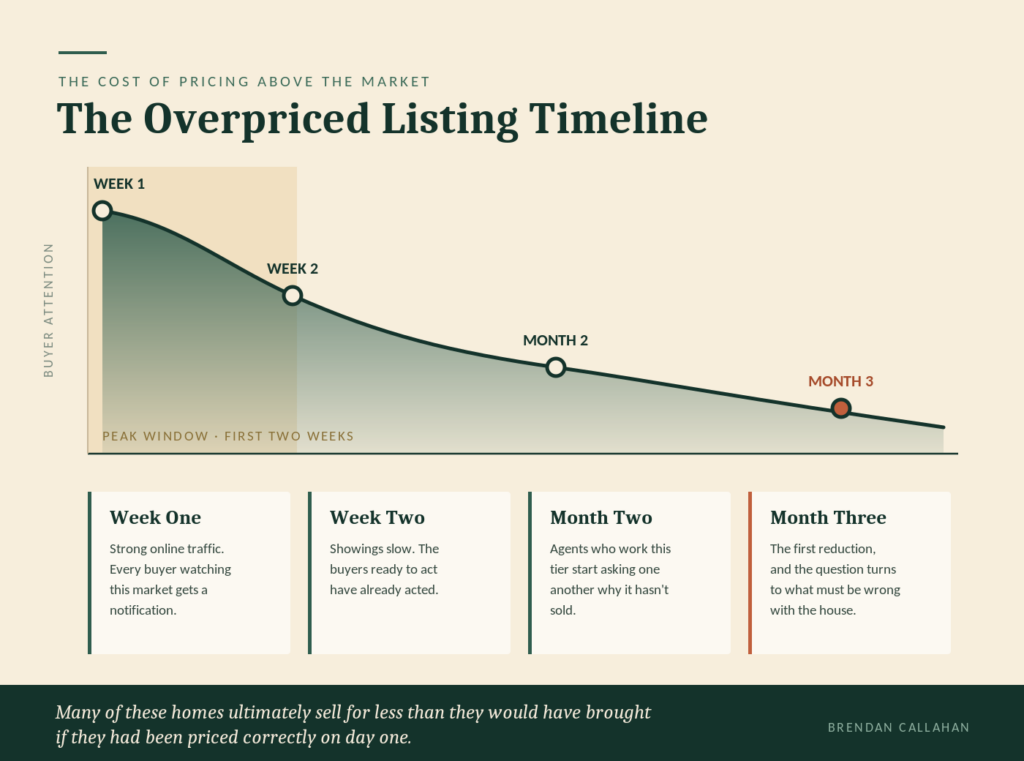
And in a market this small, an overpriced listing doesn’t just sit, it gets seen sitting. The pattern is remarkably consistent:
Week one: strong online traffic, because the listing is new. Week two: showings slow. Month two: the agents who work this tier start asking each other why it hasn’t sold. Month three: the first reduction. By then the conversation has shifted from is this home worth the price to what’s wrong with it and how low will they go.
The frustrating part is where those homes usually land. Many of them eventually sell for less than they would have brought if they’d been priced correctly on day one, and they spend a year of the seller’s life getting there. I’ve watched properties lose far more to that slow erosion than they ever would have given up by starting at a defensible number.
4. The first two weeks are the whole ballgame
It’s tempting to set an amThe day your home goes live is your single biggest opportunity, and it does not come back.
Buyers who have been watching this market for months get a notification. Local agents pick up the phone and call the client they’ve been holding a house in mind for. Your listing sits at the top of the search results. Engagement is at its absolute peak. That is the window in which excitement gets created and in a thin market, excitement is what produces competing interest.
An ambitious price spends that window on nothing.
It’s also why I do so much work before we ever go live. Photography, twilight and drone imagery, video, floor plans, brochures, the property description, the pricing strategy — none of it is decoration. It all has to be ready and working together the morning the listing hits, because once those two weeks pass, you rarely get to manufacture that level of attention again.
5. Buyers decide emotionally and justify logically
After years of doing this, I’m convinced of one thing above almost everything else: people justify a purchase with logic, but they make the decision emotionally.
The buyer standing in your kitchen isn’t tallying square footage. They’re picturing Thanksgiving at that table. Coffee on the porch with the hills going gold in October. Kids off the end of the dock in July. A ski day at Mount Sunapee or the Skiway and the fire going when everyone gets back. Friends around the fire pit when the summer evening finally cools off.
Our job is not to list features. It’s to tell the story of the home well enough that a buyer has already imagined living there before they ever schedule a showing. That’s what makes a strong price defensible and it’s the part most listings never even attempt.
6. Marketing that matches the property
Buyers at this level expect considerably more than a few phone photos and a sign at the end of the driveway. Depending on the home, a proper campaign here includes:
- Professional architectural photography, and twilight photography where the house earns it
- Drone stills and video — close to essential for waterfront, acreage, and view properties
- Cinematic lifestyle video that sells the setting, not just the rooms
- Detailed floor plans, which serious out-of-area buyers genuinely use
- Custom property brochures
- Digital advertising targeted to affluent and relocating buyers
- Social campaigns built for the property, not a template
- Direct broker networking with the agents who actually control this buyer pool
- Deliberate exposure to second-home buyers in Boston, New York, Connecticut, and beyond — a large share of Lake Sunapee’s high-end demand originates outside New Hampshire, and it will not find you by accident
The goal was never views. The goal is qualified buyers, and there’s a real difference.
7. Timing is strategy in this region, not a detail
Luxury buyers expect a premium experience. The marketing strategy should align with the home’s price Two calendars govern high-end sales here, and both are worth planning around.
The first is the academic and medical hiring calendar. A significant share of our relocating buyers commit in late winter and spring for a summer arrival, because school years and job start dates leave them no choice. Being well-positioned before that window opens is worth more than any clever pricing tactic.
The second is the light. A Lake Sunapee property is a completely different asset in July than in November. Waterfront and view homes want to be photographed and shown when the water is blue and the shoreline is alive. Mount Sunapee and the Dartmouth Skiway create genuine winter interest for second-home buyers too — but mud season and stick season are real, and no photographer fully solves them. If we’re going to market in a shoulder season, I want us doing it on purpose, with a plan for it.
8. When you do need to move, move with intention
If a well-marketed home hasn’t found its buyer, the answer is usually one real, decisive adjustment that puts you in front of a different set of buyers — not a series of small trims that signal drift and teach the market to wait.
I’d rather solve the gap without touching the price when we can. At this level there’s often more room in the structure of a deal than in the number: closing timing that lines up with an academic-year start or a hospital hire date, furnishings that were designed for the house and belong with it, the boat, the equipment, a credit toward work the buyer wants to do anyway. Buyers here frequently care more about a clean, well-timed transaction than about the last percentage point.
9. Keep Market Timing in Mind
The timing of a luxury home sale can impact pricing strategy. Consider:
- Seasonal trends—Luxury buyers often make purchases based on lifestyle factors (e.g., beachfront properties sell better in spring/summer).
- Economic conditions—Interest rates and stock market performance can influence buyer confidence.
- Local luxury trends—High-end buyers may prefer purchasing before the holidays or during the peak real estate season in Lebanon.
Adjusting pricing based on timing can help attract the right buyers when demand is highest.
Pricing a Luxury Home for Success in Lebanon
Pricing a luxury home for sale in Lebanon isn’t just about numbers—it’s about positioning the property as an exclusive, high-value investment. By understanding the nuances of the luxury market, leveraging strategic pricing techniques, and implementing world-class marketing, you can attract the right buyers without undervaluing the property. Reach out to Brendan Callahan Realtor - Susan Cole Realty Group for more help selling your Lebanon home. (603) 443-3149
